Progress after a breakup rarely looks like a straight line. Here’s how to rebuild your routine, know when to ask for real support, and what moving forward doesn’t require.
At some point, usually gradually rather than all at once, the question shifts from “how do I get through today” to “how do I build a life that isn’t organized around this loss.” That shift is what this page is about.
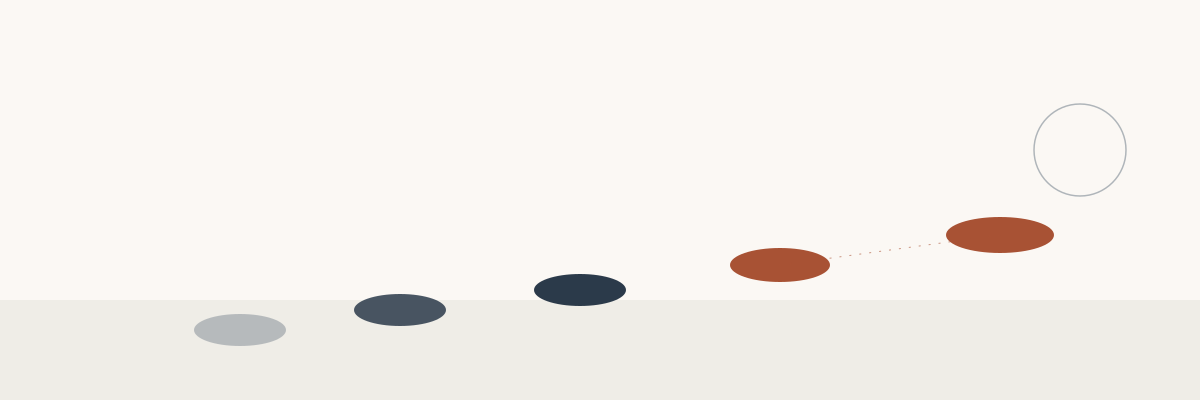
Progress rarely looks like a straight line
Most people expect healing to move steadily upward, then panic when a random Tuesday knocks them back down. A more realistic picture is a general upward trend with real dips — a song, an anniversary, a mutual friend’s photo can all trigger a setback day without meaning you’ve lost the progress you’d made.
What professional support actually looks like
Seeing a therapist after a breakup isn’t reserved for a crisis — plenty of people use a handful of sessions simply to talk through what happened with someone trained to help them make sense of it, the same way they’d see a doctor for a physical injury rather than waiting for it to become an emergency. There’s nothing to prove by handling it entirely alone.
Rebuilding the shape of your days
A relationship, especially a long one, tends to be woven into the ordinary structure of a week — who you eat dinner with, what you do on Sunday, who you text first when something good happens. That structure doesn’t refill itself. It’s worth rebuilding on purpose rather than waiting for it to happen.
People
Reinvesting in friendships or family relationships that may have gotten less attention during the relationship — not as a replacement, but because that structure matters on its own.
Routines
Small anchors — a regular workout, a weekly call with a friend, a specific morning routine — that give your days a shape that doesn’t depend on another person.
Identity
Interests, goals, or parts of yourself that may have taken a back seat. Breakups, hard as they are, often surface room to reinvest in things you’d set aside.
Knowing when this is more than an ordinary breakup
Most people move through a breakup, with ups and downs, over a period of weeks to a few months. If it’s been considerably longer than that and you’re still unable to function at work, sleep, eat, or engage with other relationships, that’s worth taking seriously as its own issue — not a personal failing, and not something to push through alone.
A licensed therapist or counselor is genuinely the right resource in that situation, in a way a website simply can’t be. Persistent low mood, panic, or an inability to function for an extended stretch deserves a trained professional’s attention, not another article.
What “moving forward” doesn’t require
It doesn’t require never thinking about them again, forgiving anyone on a deadline, or reaching a tidy conclusion about who was right. Most people who feel genuinely better a year later still have an occasional wistful thought about the relationship — that’s compatible with having moved forward, not evidence you haven’t.
Letting go of a deadline for closure
A lot of the pressure people put on themselves after a breakup comes from an invisible deadline: feel normal by a certain date, stop thinking about them by a certain milestone, be fully “over it” before some anniversary rolls around. Those deadlines are usually self-imposed and rarely match how grief of any kind actually moves. Dropping the deadline — measuring progress by trend rather than by a specific date — tends to reduce the frustration that comes from a bad day arriving right when you’d decided you should be done with all this.
A short example, not a real person
Consider someone whose weekends used to revolve entirely around their partner — the same restaurant, the same routine, most Saturdays for two years. After the breakup, Saturdays became the hardest day of the week, not because of any single memory but because the whole day had no shape without that routine. Deliberately building a new, different Saturday habit — even something small and unrelated, like a recurring class or a standing plan with a friend — tends to help faster than waiting for the old ache to simply fade on its own.
Signs you’re further along than it feels like
A memory surfaces without the sting
You think of something you used to do together and it registers as a fact, not a fresh wound — even if it’s still a little bittersweet.
Your days have their own shape again
Plans, routines, or interests exist that have nothing to do with the relationship or filling the space it left.
You can imagine good things ahead
Not necessarily involving anyone new — just a general sense that your life isn’t permanently smaller than it was.
Related reading
If you haven’t yet, it can help to look back at the breakup-processing guide and the no-contact guide — moving forward tends to go more smoothly once those earlier steps have had some time to settle.
How long does it normally take to feel better?
It varies enormously by relationship length and circumstances, but most people notice a meaningful shift somewhere in the two-to-six-month range, with occasional setback days well after that. There’s no fixed finish line.
Is it bad if I still think about my ex sometimes?
No. Occasional thoughts, especially around anniversaries or shared songs and places, are normal long after a breakup and don’t mean you haven’t moved forward.
What if I feel like I’m stuck and not improving at all?
If weeks have passed with no shift at all in how you’re functioning day to day, that’s worth raising with a licensed therapist rather than waiting it out alone — persistent stuck grief is a real, treatable pattern, not a personal failing.